Cooperative game
B@O, the board game
You, the friends of Bao the panda, set off on an adventure in the Internet jungle. There you will face many situations, good and not so good, which you will have to solve… together!
1 How it works
It is a cooperative game: you will win or lose together. You need to help each other and think about the best action cards to play to get out of the worrying situations you meet on the Internet.
- When you solve a worrying situation, Bao gains 2 well-being points.
- But Bao gets sad when his friends are in trouble: each turn a situation remains unsolved, he loses 1 point.
- The cards show icons that refer to the game’s four key topics: cyberbullying, critical thinking, Internet safety and digital addiction.
2 The characters
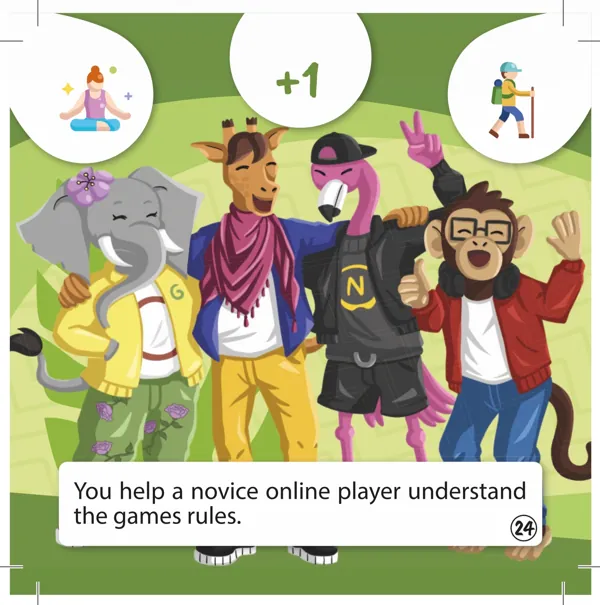
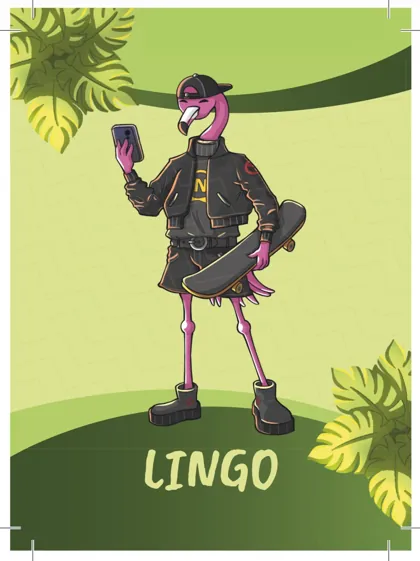
Each player chooses the figurine of the friend of Bao they want to play and places the matching character card in front of them. Bao himself moves along the well-being gauge.
- Baothe panda
- Lingothe flamingo
- Chafthe giraffe
- Gigathe elephant
- Cookythe monkey

3 Components
35 tiles
- 20 “bad situation” tiles
- 14 “good situation” tiles
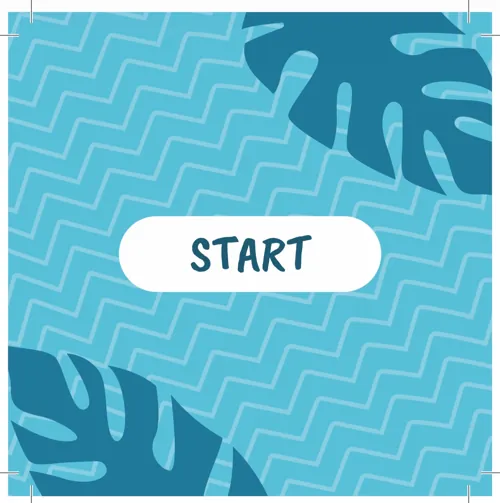
- 1 starting tile
4 gauge cards
They form Bao’s well-being scale: from 10 to 6, from 5 to 0, from −1 to −5, from −6 to −10.
36 cards
- 24 action cards (including 2 jokers and 2 “low battery” cards)
- 4 character cards
- 4 power cards (double-sided)
- 4 goal cards
5 figurines and 3 sheets
The figurines of Lingo, Chaf, Bao, Giga and Cooky, and sticker labels in French, Finnish and Greek.
The game components
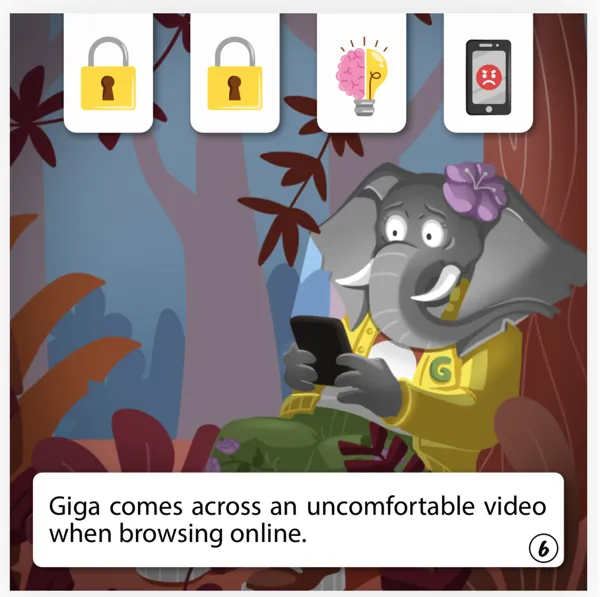
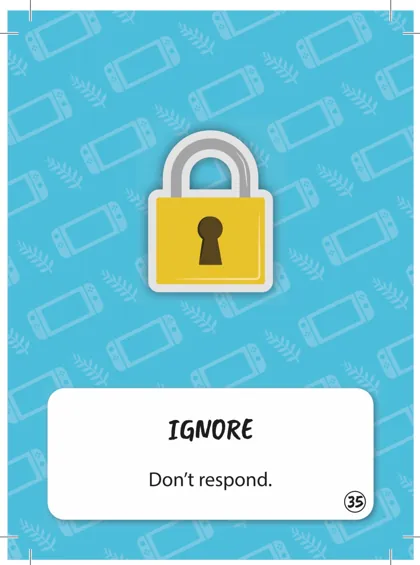
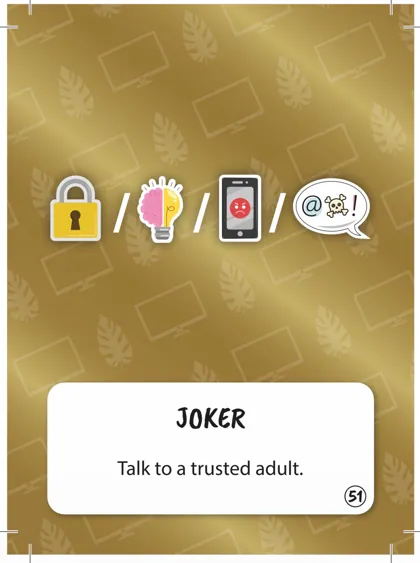
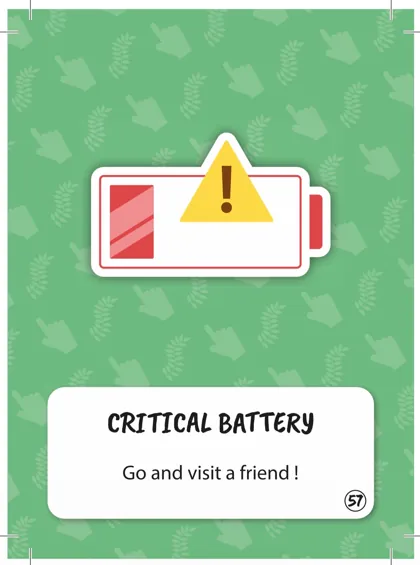
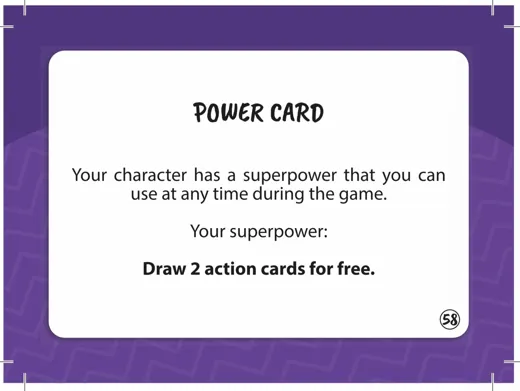
Each action card shows an icon (one of the four topics: cyberbullying, critical thinking, safety, digital addiction) and a keyword (one of the five actions: Ignore, Block, Report, Screenshot, Disconnect). You solve a tile by covering its symbols with cards showing the same icon; at level 3 you must also justify the keyword.
The visuals shown are from the international version: sticker sheets in French, Finnish and Greek are provided to translate the cards and tiles.
4 Setup
Prepare the tiles
Shuffle the good and bad tiles separately, then draw the number of tiles needed for the chosen level. Shuffle these tiles into a single face-down draw pile.
Place the starting tile and the characters
Put the starting tile in the middle. Each player chooses a figurine, places it on this tile and puts the matching character card in front of them.
Set up the well-being gauge
Lay out the gauge at the side of the table and place the figurine of Bao the panda on 0.
Deal the action cards
Shuffle the action cards and deal each player the number of cards set for the game level.
Take the sticker sheet in the language you need, cut out the labels along the lines, then stick them on the matching tiles and cards, following the numbers shown.
5 A game turn
The youngest player starts; play then continues clockwise. On their turn, each player chooses one of the following three actions:
1. Draw 2 cards
The turn ends: the cards cannot be played straight away. If you have more than 4 cards in hand at the end of your turn, put the extra cards under the draw pile.
2. Explore the Internet
The player reveals a new tile and places their figurine on it. The description is read aloud and the players can discuss it.
3. Help to solve
Play a single card with the same icon as one of the symbols on a bad tile — on your own situation or to help a friend who is stuck.
One of Bao’s friends has a positive experience thanks to the Internet. On some of these tiles Bao even gains +1 well-being point!
It requires immediate action: the player places their character on it and stays stuck until the worrying situation is solved.
Solving a worrying situation
To solve a situation, the four symbols on the bad tile must be covered by matching action cards. When a player places the fourth symbol, the situation is solved, the figurine is freed, the cards used go back under the pile and Bao gets +2 points of well-being.
If a player has not managed to unblock their situation before the start of their next turn, Bao worries and loses 1 well-being point at the start of that new turn.
This card allows no action and temporarily limits the player, who can discard it as soon as they have more than 4 cards in hand again. Its message: we need to disconnect from all screens every day. It can feel frustrating… just like having to stop playing in real life!
Alice is playing with three friends at level 1. She turns over a bad tile. One by one, her friends put down an action card to help her but, when it is Alice’s turn again, one symbol is still missing: Bao worries and loses 1 point. Luckily, Alice has the joker card “Talk to an adult” and solves the situation. The tile is set aside, Alice’s figurine goes back to the starting tile and Bao’s well-being goes up by 2 points.
6 The 3 game levels
B@O offers three levels of increasing difficulty to adapt the game to the players’ age and experience.
Level 1 — ages 6 and up
Setup: draw 5 bad tiles and 4 good tiles, then shuffle them. Make a 3 × 3 square with the face-down tiles to mark out the play area. To keep things simple, you can remove the tiles that require 4 identical icons.
| Players | Action cards per player |
|---|---|
| 2 players | 4 |
| 3 players | 3 |
| 4 players | 2 |
Well-being gauge: from +5 to −5
How to play: the players start from the “Start” tile. The first player turns over the tile of their choice and places their character on it; after that, players move freely. When a bad situation is solved, the tile is set aside and the figurine goes back to the starting tile. At this level the text is ignored: you simply match the icons.
Level 2 — ages 8 and up
| Players | Tiles | Action cards in hand |
|---|---|---|
| 2 players | 5 bad and 5 good | 4 |
| 3 players | 6 bad and 6 good | 3 |
| 4 players | 8 bad and 8 good | 2 |
Shuffle all the tiles into a single face-down draw pile. Well-being gauge: from +10 to −10
Power cards: each player draws a Power card at random and chooses one of its two super-powers. The card stays visible in front of them; this unique power can be used at any time, but only once per game.
How to play: to explore the Internet, the player draws the top tile, reveals it and places it face up next to a tile already on the table. This path of tiles represents the freedom to browse the Internet… even where you didn’t want to go! Once solved, the bad tile is turned over but stays on the table to extend the path.
Level 3 — ages 8 and up, expert mode
| Players | Tiles | Action cards in hand |
|---|---|---|
| 2 players | 6 bad and 4 good | 4 |
| 3 players | 8 bad and 6 good | 3 |
| 4 players | 12 bad and 8 good | 2 |
Dealing, draw pile and powers as in level 2. Well-being gauge: from +10 to −5 (harder!)
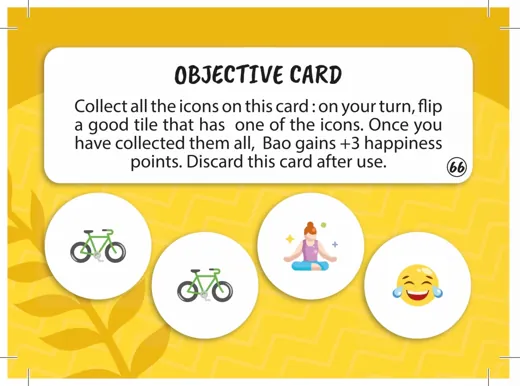
Goal cards: each player secretly draws a Goal card. It shows healthy habits, symbolised on the good tiles, to collect:

Doing sport

Getting some fresh air

Relaxing and switching off screens

Having fun offline
When a player turns over a good tile during their turn, they can keep it to complete their goal (their figurine then goes back to the start). As soon as a player has collected all the symbols of their goal, the gauge immediately rises by 3 points.
Justify your action: as well as matching the icons, the player must explain aloud how the keyword on their card (Ignore, Block, Report, Screenshot, Disconnect) helps the character in the situation. The other players check that the explanation makes sense; if not, another card must be played or another action chosen.
If there is a 5th player, they have no character on the board: they play the all-powerful referee and approve (or not) the explanations given when situations are solved.
Aïcha is stuck on a tile where Chaf is worried about how many “likes” he has. Hugo has a card with the digital addiction symbol, but the keyword on it is “Screenshot”. He can’t explain how a screenshot would help Chaf: without a convincing argument, he chooses another action (drawing two cards), hoping to get a more suitable card next turn.
7 Simulator: Bao’s well-being gauge
Test how game events affect the gauge. A good way to explain the rules before playing!
Goal cards (+3) only exist at level 3.
8 Aim of the game and end of the game
If Bao reaches or goes beyond the maximum well-being level, or if the players have overcome all the risky situations they met without ever reaching the lowest point on the scale.
If Bao reaches the lowest point on his scale (−5 or −10 depending on the level). Then take time to think again, together, about the situations that caused you difficulty.
9 Download and print the game
A few copies were printed when the game came out, but the whole project can be downloaded and printed for educational use.
Game rules
Kit to make
Cards, labels, figurines… all the material to print to make your own game box.
Want to go further? The FabLab project suggests having pupils make the game themselves.